Peppermill-Stories

At the studio of Sabina Grzimek, they discuss the decisive influence of the Pfeffermühle Community on culture and art in and around Halberstadt, as Bärbel and Klaus Herre were among its founding members in 1970.
Klaus Wilhelm Heinrich Herre was born in Rudolstadt in 1941. He clearly remembers the bombing of his grandparents’ house. Traumatized, the small family moved to the north of Demmin. From 1961 to 1963, he studied naval architecture in Rostock for three semesters. During the construction of the Berlin Wall in 1961, the students were forced in a cloak-and-dagger operation to go to the shipyard one night to weld tank barriers out of steel beams. Everyone was disconcerted, but no one suspected the true reason: in the early morning of August 13th, not only the country but also families would be ruthlessly separated. Nevertheless, life in the GDR, in the »Eastern Sector«, went on. From 1963 to 1964, Herre completed an apprenticeship with Hans Plog in Demmin, earning his journeyman’s certificate, and in 1965 worked for seven months as a skilled worker for Master Silversmith Böge in Halle. He escaped the tyrant when he was offered a position as a skilled worker in the metal workshop at Giebichenstein Castle. There, between 1967 and 1968, he privately financed his master craftsman training in copper- and silversmithing, but continued to work as a tutor at the university until 1970.
Klaus Herre describes this turn of events as a streak of good luck. The students were assigned projects by their professors as part of their coursework. Herre recounts, that the metal workshop focused exclusively on coldforming work. He was able to pass on many of his craftsmanship skills there, but he also learned a great deal himself, because, following the Bauhaus model, there were highly trained Masters in all areas. He also carried out projects there, such as work on Prof. Hünecke’s »Dancer«, and commissions from the Burg, such as gifts ordered by the government for state or regional guests. In terms of artistic discourse, he experienced a steep and motivating learning curve. Due to the Prague Spring, he was suddenly drafted into the reserves in 1968. Bärbel remained alone in Halle with their two young children.
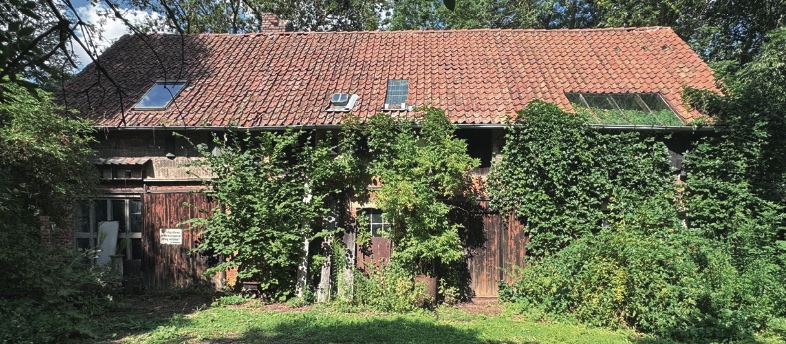
Bärbel-Ute Herre was born in Loburg in 1945 and trained as a goldsmith in Köthen. After completing her apprentice- ship, she received a visit from Prof. Pfitzermann, who recruited her to work in the goldsmithing workshop at Giebichenstein Castle, where she would instruct the students. The goldsmithing site was directly linked to the enamel department, where Prof. Irmtraud Ohme worked. Inspired by Ohme’s work, Bärbel Herre considered pursuing a college degree in Heiligendamm. However, caring for her seriously ill child forced her to give up her position at the university in 1967, following the birth of their second daughter. The move to Halberstadt was very difficult for her, but the opportunity to set up her own independent workshops offered a ray of hope. In 1981, she became a Master Goldsmith in Dresden.
Before the fall of the Berlin Wall, the Pfeffermühle community participated as a united group
in various actions. Klaus Herre also took on the role of leading meetings. The situation was
precarious; participation in meetings and demonstrations had to be discussed, because who would
care for the severely disabled daughter in the event of an arrest? After the fall of the Wall,
Klaus Herre’s task was to prevent the destruction of the Stasi files in Halberstadt.
As a founding member of the New Forum, Bärbel Herre was involved in the Monday demonstrations;
after the Reunification, she volunteered with the Independent Women’s Association and the
Moses Mendelssohn Academy. Since 1990, she has volunteered with the Refugee Aid Association,
assisting families with children. In 2001, she received the ›Silberner Roland‹ award from the
city of Halberstadt in recognition of her service, and in 2017, she was awarded the
Federal Cross of Merit on Ribbon by Federal President Frank-Walter Steinmeier for her
volunteer work. Since 2013, she has been an indispensable supporter of the MKH-Biennale.
Klaus Herre became a cofounder out of affectionate compassion, so that his daughter’s idea,
to reignite contemporary exhibition in Halberstadt gain momentum.
Shortly after moving into the Mill, Hans Scheib stayed with Herres in 1970.
Hans-Hermann Richter knew Scheib’s wife from a college program in Sonneberg.
Since the daughters of the three families were of the same age, close friendships quickly
developed among the children. Freelance artists were in a tricky position during school
breaks, as summer camps were often reserved only for company employees.
Thus, the Herres’ open home and the Mill—with its workshops on the Goldbach, the old barns,
the Mill weir, and the adjacent fields, meadows, and forest with its
animal enclosure—often became a holiday paradise. An etching by Scheib,
»Mimi with Bärbel’s hat«, documents one such vacation visit by the daughter of artist
Karla Woisnitza. Sabina Grzimek and her two children were also welcome guests.
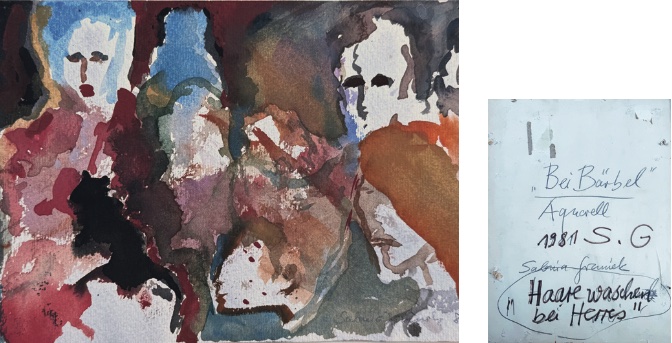
The summery colours of the work »Washing Hair at the Herres’« reflect the seemingly
endless summer days at the Mill.