PRESENT AND REFLECTION
On August 30th 2026 the VI. MKH-Biennale opens in Halberstadt, because the art world never stands still. It constantly reflects on the present, which is shaped by the past. The VI. MKH-Biennale brings together artists from various regions of eastern Germany. They were critical of the system in the GDR and continue to engage critically within the present day. Sabina Grzimek, Peter Herrmann, Helge Leiberg, ilka Leukefeld, Hans-Hermann Richter, Hans Scheib, Inge H. Schmidt, and Johann-Peter Hinz—in whose honour a sculpture trail winds through Halberstadt, will contribute their work to this years bieannial in order to reflect on the present. We are very grateful to them for this.
I herewith express my heartfelt gratitude to the generous support of the Chairman, Dr. Frank Aedtner, and the Executive Board of the Kuratorium Stadtkultur Halberstadt e.V., which supports the MKH-Biennale on a voluntary basis as one of its working groups; to the City of Halberstadt as patron, with Daniel Szarata as Lord Mayor; and to the Director of the Gleimhaus, Dr. Ute Pott, whose knowledge and willingness to help have been invaluable in paving the way for the biennial.
In cooperation with the City of Halberstadt, we have been providing an internship position
for the Harz University of Applied Sciences since 2014. We would like to take this opportunity
to express our appreciation to the intern, Martin Kraus and Franziska Eggert-Münnich of the
MKH-ORGA Team, the volunteers, the evangelical Church Community, the MKH-Friends’ Association,
and all of our sponsors.
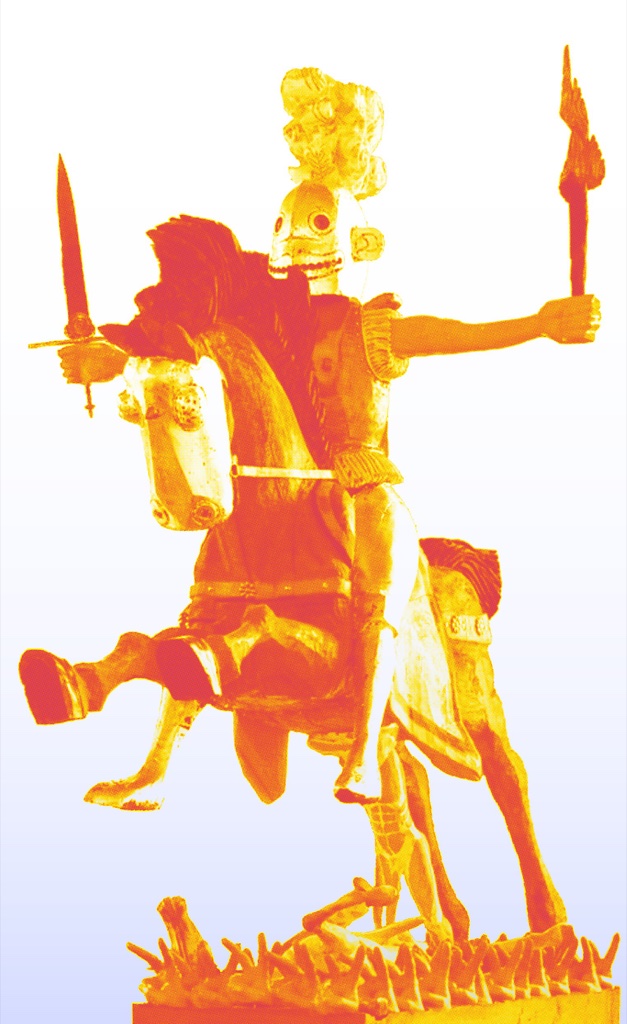
Our thanks also goes to Ursel Scheib (alias: Anna Cumin) for lending
us the Four Horsemen of the Apocalypse, because a statement of the sculptor Hans Scheib was
crucial to the development of the exibition PRESENT AND REFLECTION. With his family and a
few friends, we were sitting in a cozy country pub near his studio in Stegelitz in the
Uckermark. During the conversation, he remarked: »I’ve always had an affinity for Halberstadt
and would like to exhibit there again.«
As early as 1970, a visit by Scheib and other art students from Dresden to view the
cathedral treasury, the Gleimhaus and St. Martini Church, led to friendly relationships
with Bärbel and Klaus Herre, Hans-Hermann Richter and Johann-Peter Hinz of the Pfeffermühlen
collective based in Halberstadt.
In the 1980s, metal artist Hinz began organizing exhibitions at St. Martini Church,
inviting, among others, Hans Scheib and Sabina Grzimek. The first exhibition left a
lasting impression on many people.
Over the years, cross-generational friendships developed between artists from Berlin and
Halberstadt. This sense of connection and long-standing friendships demonstrate,
that art is not only a form of individual expression, but can also be a way of fostering
understanding and overcoming barriers and prejudices, personal experiences, or political
events. At a time marked by divisions and conflicts, these people are sending a powerful
message of liberal thinking through art. They demonstrate, that art is a universal language
that not only crosses borders, but also brings people together and forges connections.
The exhibiting artists have gained recognition both nationally and internationally.
Through their long-standing participation in exhibitions and publications,
regional projects, art workshops, symposia, artist residencies, international collaborations,
and works installed in public spaces, they make a significant contribution and succeed in
bridging the gap between tradition and modernity.
The artworks exhibited as part of this Biennale are also gaining significance in light of the
immediate future—the slowly eroding democratic values within German politics, what appears
to be an ever-widening rejection of new developments, and the upper class’s disregard for
those in need. All of these are issues that underscore the importance of critically examining
political processes, whether through the interpretation of images or open dialogue.
Guests of the biennial are cordially invited to engage in discourse and, through the exchange
of ideas and reflection, to gain new insights and perspectives.
For children and young people, too, engaging with art can provide important inspiration for
creativity and critical reflection. In cooperation with kindergartens, schools, and vocational
training centers, we therefore offer workshops and guided tours. In addition, we offer
lectures and discussion groups to create a space open to democracy within the art scene.
Funding for these initiatives was provided by the alliance »Partnership for Democracy in the
Harz District«, and we are very grateful to Ms. Selke and her colleagues for their support.
A satellite art trail, beginning at St. Martini Church, offers a stroll through Halberstadt.
Two small figurines, never before exhibited in Halberstadt and the impressive steel chandelier
by our friend, artist, and honorary citizen of Halberstadt, Johann-Peter Hinz, lead from
St. Martini Church through the city to the main train station, where his sculptures can be
experienced. At the same time, this art trail connects visitors to other landmarks, institutions,
and art projects, such as the Cage Project at Burchardi Monastery. Since 2014, the MKH-Biennale
has been bringing young, national, and international art to Halberstadt.
This time, we are focusing on artists who are rich in life experience. Some of the exhibitors
were traumatized in their early childhood by experiences of the Second World War;
others process the experiences of their own families during the dictatorship of the Third
Reich—always critically, always scrutinizingly; or were affected by the repercussions of the
subsequent developments. Despite all this—or perhaps precisely because of it—their artistic
practice is firmly anchored in the present.
From a master class in drawing and painting to various performances in the sacred space of
St. Martini Church—a space that citizens and artists have made their own since the 1980s—the
biennial offers its visitors a wide range of experiences. This artistically valuable art project,
carried out largely by volunteers, continually transforms unique places in unique ways.
The MKH-Biennale team offers you, the audience, opportunities for contemplation and debate in
public spaces, entirely in the spirit of Greek democratic ideals.
Deep thoughts that wind through history and contemporary events are shared for contemplation—and,
dear art lovers, those who yearn for art, and curious observers, it is not only a pleasure but a
genuine need for me to present this art exhibition in Halberstadt.
I wish you all an inspiring, peaceful, and convivial time at the VI. MKH-Biennale.
ilka Leukefeld
Initiator of the MKH-Biennale