Pathos of Nearness
In order to establish a »tangible«, human scale in contrast to the more or less abstract
“constructions of history” that are detached from the individual, Walter Benjamin makes a startling proposal in his
famous »Work on the Arcades«: if one imagines a line of people, each of whom dies at the age of fifty
on his son’s birthday, the total number of people since the birth of Christ amounts to just forty.
What henceforth emerges, Benjamin calls a »Pathos of nearnes«.1 If we—just to continue thinking along
these lines—take the year of birth of Peter Herrmann, the grand seigneur of this exhibition, as a fixed point,
a hundred years are already within sight. From the age of seventy onwards, for many the depth of their
own existence becomes increasingly unfathomable, eerie even. Time reaches a different dimension.
In early November 1937—when little Peter was just half a year old, Adolf Hitler spoke for the first
time about his war plans during a secret conference at the Reich Chancellery in Berlin. And
thirty-seven kilometers, as the crow flies between Peter Herrmann’s birthplace and mine.
Today, that route leads us right across the Czech Republic, passing through places whose names we,
as children, first heard from the so-called »resettlers«. They seemed out of reach to us, only a few
kilometers from the border, where we lived. Prague felt nearerby; one of our class- mates was
friends with a boy of the same age there. So in 1968, when the Soviets marched into what was then
Czechoslovakia through our village, we viewed the event from two different perspectives. On one
hand, we saw the endless convoy of vehicles, from which cigarette packs kept falling off.
And we saw the Russian soldier, just a few years older than we were, whose amphibious tank had
broken down just before the border. We visited him almost every day. Apparently, he fed exclusively
on apples from the trees lining the road. On the other hand, reports arrived from Prague—the friend
of a friend—that tanks were rolling through the streets, and that Soviet soldiers were shooting
people. A similarly dissonant perception seems to coalesce into a single image in Peter Herrmann’s
work, titled »In the Saxon Forests—August 1968.« A monstrous military machinery breaks through a
forest, tanks, faceless soldiers, interspersed—as an obviously surreal element—with giant mushrooms,
and in the foreground, two soldiers, each holding a mushroom whose caps resemble their helmets,
except that they are of different colour. If we try to reconcile this image, created in 2003,
with socalled historical reality, failure is inevitable. It seems as though the supposed reality,
our »construction of history«, is blocking our view of the image. We can, much like Walter Benjamin,
imagine forty human lifetimes into the future. In two thousand years, the Prague Spring will likely
be no longer more than a footnote in the history books—if history is still being written at all.
Unburdened by historical specifics, what an obscure surreality, what a—in the literal
sense—strange puppet show between idyll and catastrophe unfolds here. It is its unreality that
brings the image right up close to us, »closeness through distance«2,
a process we also recognize
from everyday life. The proverbial shift in perspective— however it may come about—alters not only
the realm of associations in art, but fundamentally our perception of the entire fabric of the
world in which we are placed, and, of course, the meaning of the terms we use.
With this exhibition of works by befriended artists who have remained friends through the ruptures of time—a point of
reference emerges here, at the specific location of St. Martini Church in the center of Halberstadt, one that I cannot
overlook, just a stone’s throw away and barely three hundred years remote. When Johann Wilhelm Ludwig Gleim, a law
graduate, moved from Berlin to Halberstadt in 1747 to take up the position of cathedral secretary, he began commissioning
portraits of his fellow poets, who lived far away, to always have them close by. The project later culminated in the
»Temple of Friendship«, which can still be viewed at the Gleimhaus today.
The Berlin-Halberstadt axis thus has a certain tradition when it comes to friendships among artists.
The fact that a temple was dedicated to interpersonal relationships rather than to a god, reflects the tremendous
transformation which took place during the 18th century. In the following century, it was already the products of the
rapidly expanding capitalist commodity production, for which temples made of steel and glass were erected, while the
actual houses of worship—which Christians call churches—gradually began to empty. A development that would later,
after two world wars, be further accelerated in the GDR by an atheistic ideology. In the war-scarred emptiness of
Halberstadt’s city center, St. Martini Church, with its mismatched towers, was a significant symbol of this
development as well. When, in June of 1984, contemporary art made its debut under the Gothic vaults of
St. Martini Church in June 1984 with the exhibition »Plastik in der Martinikirche«, that, too, was a sign.
It marked the conquest of a long-neglected space of possibilities that represented half a millenium, in a country,
that confronted its inhabitants with impossibilities on a daily basis. Among the artists exhibiting there were,
alongside the initiator Johann Peter Hinz, Sabina Grzimek exhibiting a small family, and Hans Scheib with his
impressive »Halberstadt Figure«.
At this time, I knew nothing of the network of friendly relationships behind the exhibition.
Thus did I not know that Scheib was, so to speak, already sitting on his packed luggage, that 1984 was,
for the artists gathered here today, something of a »watershed year«. Inge H. Schmidt, Hans Scheib, and Peter Herrmann
left for West Berlin, the latter with a slight detour via London and Hamburg. Helge Leiberg was expelled.
Apparently, none of them wanted to live in West Germany. The others—Sabina Grzimek, Johann-Peter Hinz, and
Hans Hermann Richter—stayed in Halberstadt, in Huy-Neindtedt and in Berlin.
ilka Leukefeld, who was merely seventeen years old at the time, now visualizes this web of relationships.
Her video installation adds a lively part to the exhibition.
With the exception of Peter Herrmann, it was the younger generation who left the GDR.
Coincidence or not, but perhaps noteworthy besides their age is, that those who stayed were born outside the borders
of postwar Germany. They already had some kind of experience as refugees. Here, Peter Hermann was an exception too.
Like Hans-Hermann Richter, he experienced the bombing of Dresden— not as a toddler like Richter, but as an
eight-year-old boy. Noteworthy is, that this exodus towards the West, which had steadily been growing before the fall
of the wall, subsequently developed into a mass phenomenon, triggered primarily by the economic collapse of the east.
Artists no longer played a role in it. Instead, they were cast in one of the two leading roles in the tragicomic
sequence of events surrounding the so-called German-German art controversy. With calculated provocation,
Georg Baselitz—who passed away this year—had set the stage with an interview in the art magazine »art«.
To be allowed to call oneself artist, according to his dictum, one would have had to have left the country in time.
Baselitz was still able to commute between East and West Berlin by S-Bahn in 1957–58.
Too bad for the younger generation. Even a merely sketchy account of this »dispute«—which, thankfully, has since
received a well-founded scholarly analysis in Anja Tack’s book 3—would far exceed
the scope of this article.
Yet one of the sad peaks of the dispute leads us back to this exhibition—yet another exhibition.
It was titled »Official and Unofficial—The Art of the GDR« and was held in 1999 at the former Gauforum in Weimar.
For many visitors it was particularly reminiscent—especially in terms of the manner of presentation—of the
»Degenerate Art« exhibition shown by the Nazis in 1937.
Presentation of the exhibition in Weimar escalated into a scandal, because the artists Ralf Kerbach and Reinhard
Stangl—both of whom had already emigrated to West Berlin in 1980 and 1982—publicly withdrew their works on display
in protest, thereby drawing significant public attention to the defamation. In this context, it must be mentioned
that Reinhard Stangl and Hans Scheib belonged to a group of artists around Christine Jackob Marcks.
Her design for a memorial to the murdered Jews of Europe had won one of the two first prizes in a 1994 competition
initiated by a citizens’ initiative and had been favored for implementation; the project failed due to a veto by
then-Chancellor Helmut Kohl.
This was followed by a further competition, which led to the current memorial by Peter Eisenman.
Let’s take a step back. From 1978 to 1981, Hans-Hermann Richter was a master student under Willi Sitte who,
in my opinion, under different circumstances, would have had the chance to become one of the greatest
art forgers—but his political ambitions led him into a different direction.
One year after being his master student, Richter painted several pictures called »Factory hall«. One of which made
it into the 9th Art Exhibition of the GDR in Dresden.4
One might assume that his time as a master student was a success. The central elements in the seemingly chaotic
space that Richter depicts in his painting are seven industrial lampshades, which are highly sought-after in the
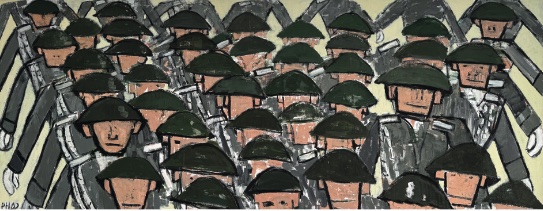
antique trade today. Yet even their light cannot bring clarity. Only in the lower left hand corner appears a group of
workers wearing hard hats. Each of their heads are looking in a different direction. It is a farewell image and if
it was a letter, it would not be a notice of resignation but a letter of dismissal, relieving the leadership of
their duties. It is the same exhibition, where »Gefallenes Tier« 5
by Johann Peter Hinz was also on display. A small, wonderful study of it is presented at the MKH-Biennale.
For the first and last time, visitors to the Albertinum can view a print by Helge Leiberg under the telling title
»Horizont III«. 6
It is a surreal landscape of figures, that comes closer to a preemptive letter of termination.
Two portraits by Sabina Grzimek are additionally shown to the large bronze »Mother with Child« 7
– simply vulnerable beings, stripped of everything, one might presume. One could find many works comparable in their
artistic honesty toward themselves and their own body of work. There isn’t enough space here to list them all.
By way of example—perhaps because it is not so well known—let us refer to the painting »Cement Plant« by the
Halle-based painter Gerhard Schwarz, depicting a factory, as a kind of »Death Island«.8
Viewed from the distance of several decades: is it not possible to read the art history of the GDR as a permanent
process of emancipation? As a process of emancipation from the demands for validation by a political elite, that was
in many respects quite obviously overwhelmed and also inexperienced, whose obscure demonstrations of power were
at the same time—and involuntarily—demonstrations of their own powerlessness?
Is this repeating itself? And were/are the paintings actually the ones in power? If we were to reconstruct a country
based solely of those paintings, what would it look like? What does the country look like, that we reconstructed from
this exhibition?
In moments of melancholy, I sometimes wonder how many paintings or sculptures on the vast floors of the world’s
great museums are now merely fading into obscurity, existing only as evidence, as a record of something that one
knows, has known, or even just believes or believed one knew. There are no longer any eyes to bring them to life.
They certainly existed once and at some point in the future they will exist again—perhaps; I’m not sure.
This exhibition, too, is evidence, and it documents what matters. In my opinion, in a very impressive way.
It wasn’t that long ago that I reflected on this very topic on the occasion of an exhibition by
Hans-Hermann Richter.9
In any case, not on leaving or staying. Rather, on the way in which one stays, or indeed leaves.
The works in this exhibition are beautiful, comforting, and encouraging proof of this, thank God, thanks to
Nietzsche. The collision with the political realm does essentially always have a secondary effect on the artist,
unless they are a political activist, producing »art« in pursuit of this commitment. The internal relationship between
artist and work succeeds only in truthfulness, as an attempt at a »true« life,
no matter where in this world.10
For Hans Scheib, artists such as Albert Ebert (1906–1976) from Halle, Charlotte E. Pauly (1886–1981), and the
Berlin-based draftsman Egmont Schaefer (1908–2004) are the »true heroes«,11
—significantly, none of the so-called »successful artists«. What connects them to the artists featured in this
exhibition seems to me, to be their unpretentious striving for immediacy—a »pathos of nearness«, if you like.
There are no sleight-of-hand tricks. As it is painted, so it is meant. Nothing for eternity. For the painting,
the figure, there is only that moment where somebody ́s eyes, in the truest sense of the word are opened.
For and in that moment, a work of art lives and inspires to live; that is why it is created.
Only in this moment does it truly exist—for that fleeting glimpse of eternity in the here and now.
I wish you and the works you encounter in this exhibition many such moments.
But be careful—they are not only the most vivid, but often also the most dangerous.
| 1 | Walter Benjamin, The Arcades Project, Vol. 2, Frankfurt am Main 1982, p. 677. |
| 2 | A line from the poem »Für Elise« by Richard Leising (1934–1997) from: Die Rotzfahne, Ebenhausen near Munich, n.d., p. 10. |
| 3 | Anja Tack, Riss im Bild: Art and Artists from the GDR and German Reunification, Göttingen 2021. |
| 4 | IX. Art Exhibition of the GDR, Berlin 1982, p. 253. |
| 5 | Ibid., p. 328. |
| 6 | Ibid., p. 238. |
| 7 | Ibid., p. 124. |
| 8 | Ibid., p. 74. |
| 9 | Norbert Eisold, “»Worauf wird es ankommen?«, in: »OT« Huy- Neinstedt, Hans-Hermann Richter, Halberstadt 2024. |
| 10 | The remark refers to Theodor W. Adorno’s oft-quoted dictum that »there can be no real life in the unreal.« |
| 11 | Based on the interview by ilka Leukefeld with Hans Scheib. |