»The Guitar Player«, Scheib’s first sculpture in a public space,
was installed in 1976 at a youth club in Halberstadt.
Peter Hinz had certainly put in a good word for this commission, which came shortly after Scheib
completed his art studies in Dresden. Further group exhibitions in Halberstadt cemented their mutual
admiration.
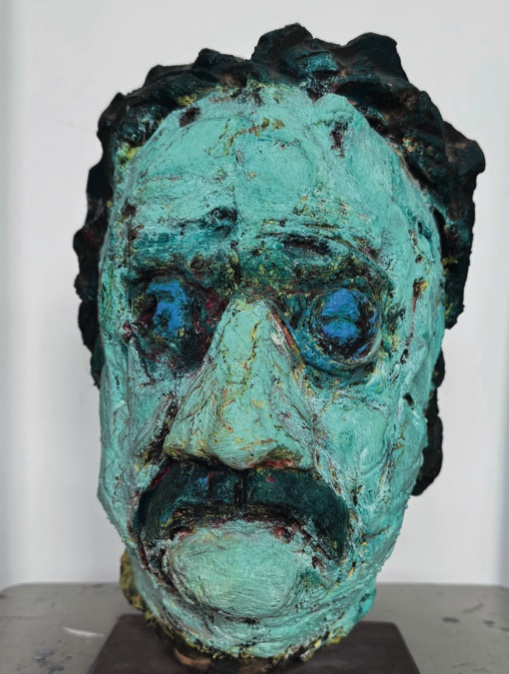
Scheib’s figures appear unpolished, rough, and often uncomfortable—and that is exactly how Scheib
saw himself in the GDR.
His aversion to Socialist Realism connected him with his friends A. R. Penck, Strawalde, and
Peter Herrmann.
In 1985, the family emigrated to West Berlin. It was a tragedy of separation that had heartbreaking
consequences for their entire circle of friends and their children, who were close friends themselves.
But Scheib, like so many others, felt stifled and patronized; they could no longer find their footing
in the GDR.
In West Berlin, he met, among others, Inge H. Schmidt, Reinhardt Stangl, Helge Leiberg, and again
Peter Herrmann—migrants who had also traded their homes for the unknown. Together, they organized
nearly 40 joint exhibitions at home and abroad.
He didn’t work on commission. What he did; ›... was my own idea, something that took shape in my head.
I can’t blame anyone else for that,‹ he said with his unmistakable, mischievous smile.
It wasn’t until his later years that he began creating bronze sculptures.
In the GDR, raw materials were scarce, but lumber was available: ›If it became a virtue, it was born
out of necessity. ... Paint it!—Build it up and destroy it—that’s what gives the work a certain
structure. That really resonated with me in my woodwork.‹
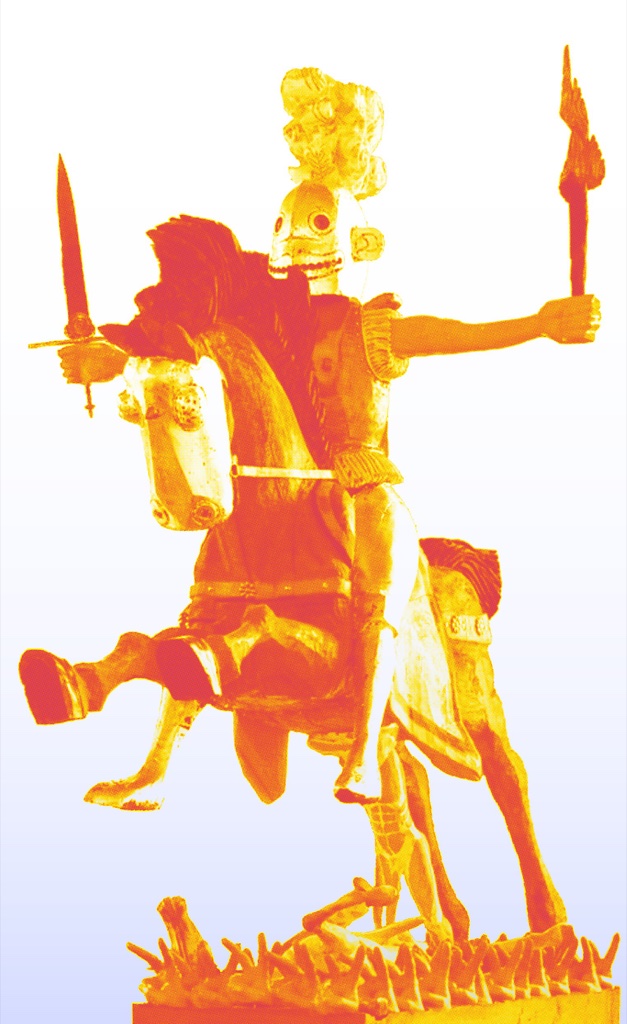
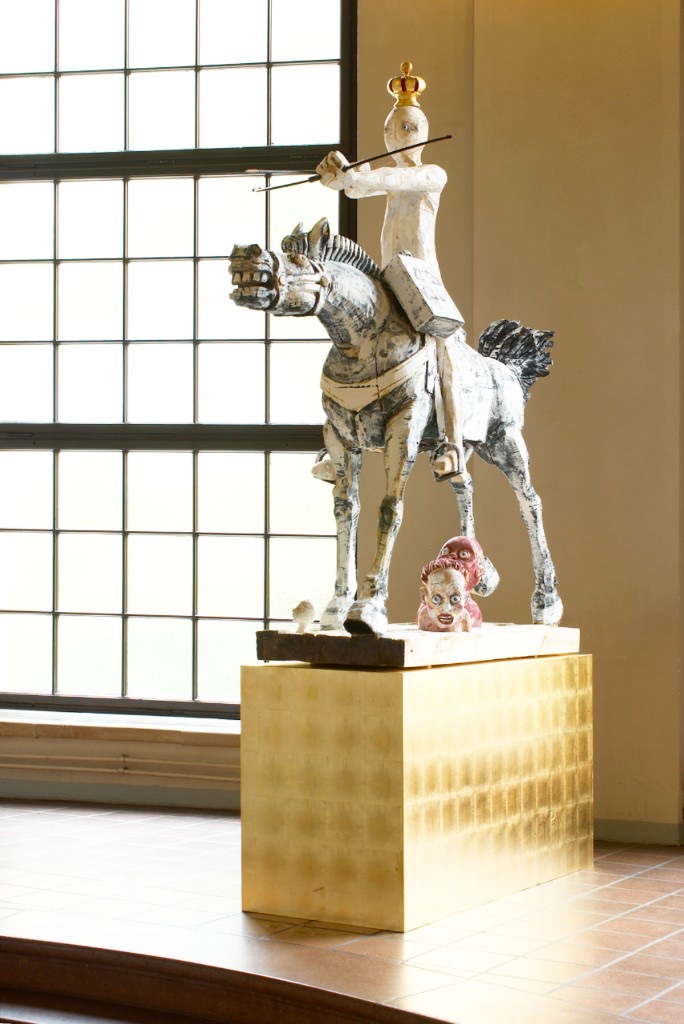
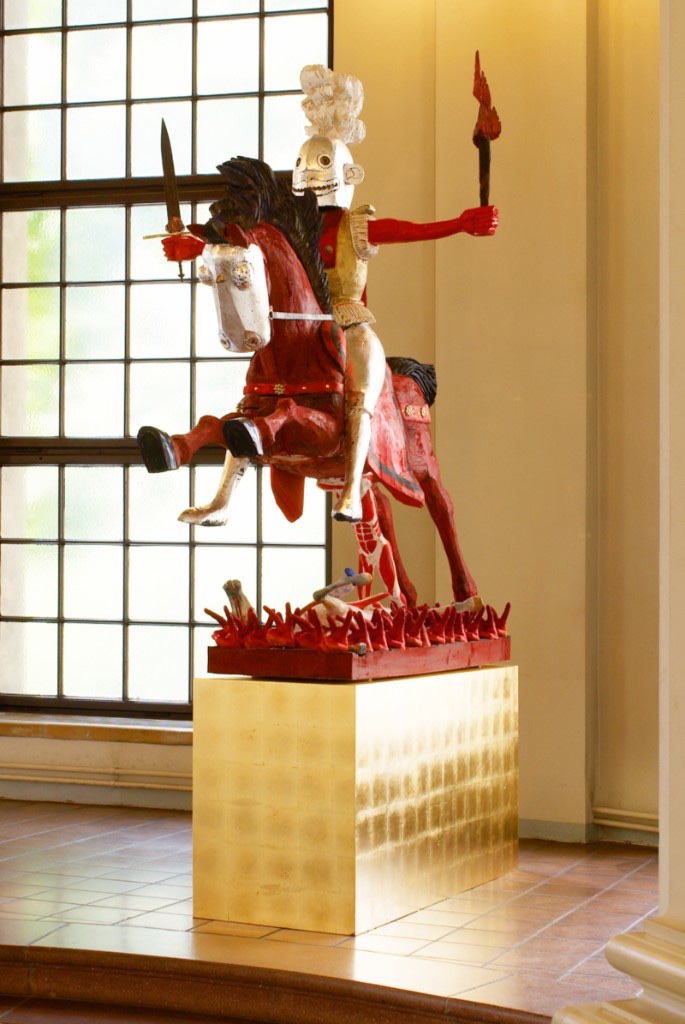
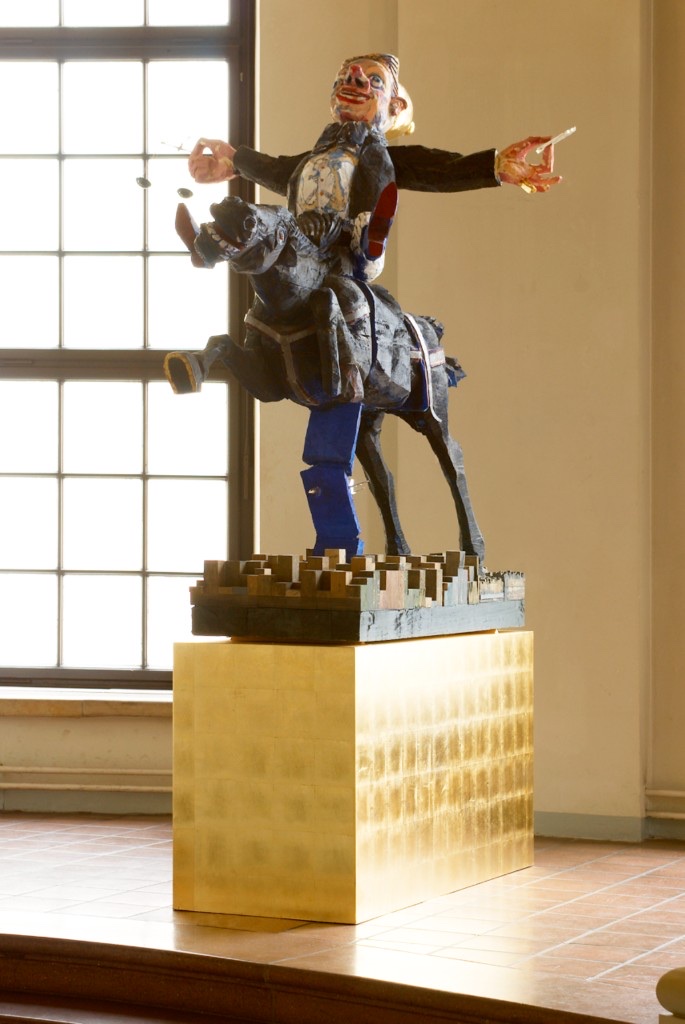
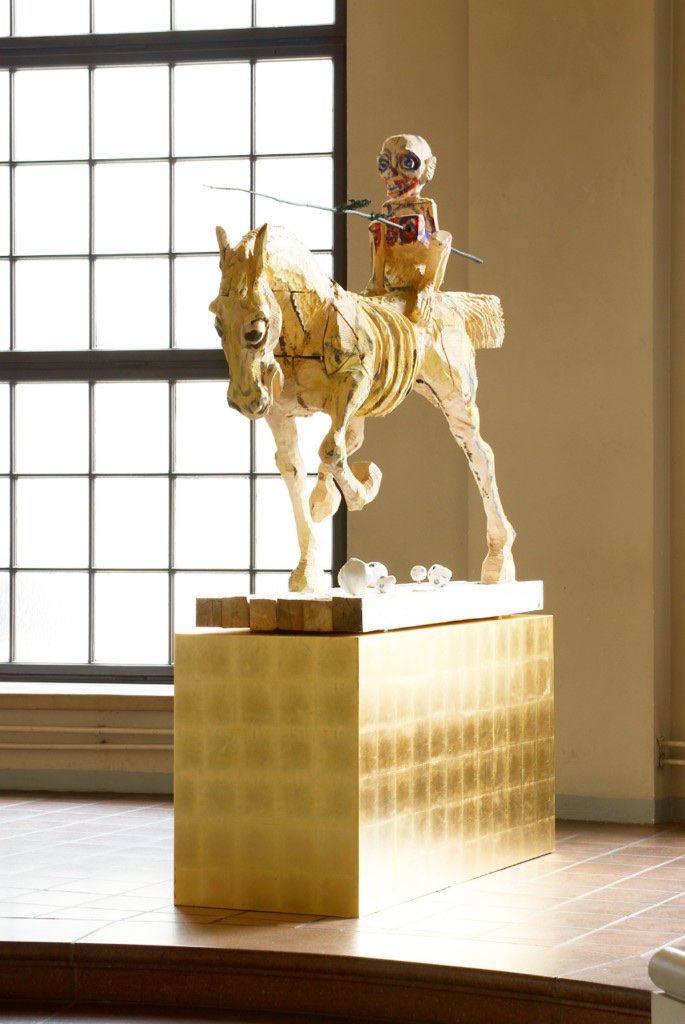
Scheib’s life-size wooden figures of the Four Horsemen of the Apocalypse on their wild horses are
shocking; they make us think of the devastating consequences of war. They serve as a reminder of
cowardice and dictatorships; they are terrifying because they resonate so deeply with our own feelings
when we think of Ukraine, Palestine, Israel, and ›Monday demonstrations‹ that have been hijacked for
other purposes.
Dried-up rivers, uncontrollable wildfires—and on top of that, powerful dictators who maliciously and
out of pure greed prevent the urgently needed measures for environmental and animal protection—the
Four Horsemen of the Apocalypse from the Book of Revelation, a recurring theme in art history and
depicted in detail by Albrecht Dürer in a woodcut published in 1498, are held up to us as a mirror
by Scheib’s expressive sculptural interpretation at the VI. MKH-Biennale.
Scheib has always worked. Whether in the studio or carving during the Pfeffermühle Easter outing while sitting
under a tree, but in between, there was time to celebrate because: ›A little cheerfulness is a must,
if possible.‹
»The Guitar Player« was recovered in a severely damaged condition, when the Salut Youth Club (part
of the new construction project in the 1970s) was demolished in 2025.
It would be a great asset for the city of Halberstadt to have this statue restored in memory of
Hans Scheib, as our beloved friend and colleague passed away in April of this year in
Berlin-Charlottenburg. His genuine warmth, intelligence, lively discussions, and cheerfulness are
sorely missed.
Hans Scheib
Graphic Artist / Sculptor
| 1949 | Born in Potsdam; grew up in Berlin |
| 1966–69 | Apprenticeship as a typesetter; high school diploma; military service |
| 1971–76 | Studied sculpture at the Dresden Academy of Fine Arts |
| 1976 | Freelance sculptor in East Berlin |
| 1985 | Moved to West Berlin; first exhibition at the Haus am Waldsee in 1986 |
| 1989 | Small bronze sculpture HYPERION for the Carlo Schmid Prize Carlo Schmid Foundation, Stuttgart |
| 1994 | Invited to the »Art < Politics« conference, Aspen Institute, Aspen, Colorado |
| Since 2001 | Member of the Free Academy of Arts, Hamburg |
| 2004 | Study residency at the Villa Romana, Florence Studio in Kolchis, Tbilisi, Georgia |
| 2005 | Invited to the 2nd International Beijing Biennale, China |
| 2006 | »Pirosmani’s Table« project, Tbilisi, Georgia, and Yerevan, Armenia |
| 2007 | Visiting Artist at Oberlin College, Oberlin, Ohio |
| 2008 | Listros project in Addis Ababa, Ethiopia |
| 2010 | Breakthrough project, USA, in Nashville, Aspen, Washington, San Antonio, and Chicago Invitation to the 4th International Biennale, Beijing, China Istanbul Art Fair |
| 2014 | Egmont Schaefer Prize for Drawing 2014, Berlin Moved studio to Berlin-Spandau Participated in the first MKH Biennale in Halberstadt with the sculpture »Diogenes Seeks the Good, the True Human Being« |
| 2019 | Invitation to a sculpture workshop during the State Garden Show in Wittstock/Dosse Pillar figures ADAM and EVA in St. Mary’s Church |
Awards
| 1995 | Art Promotion Prize from the Academy of Arts, Berlin; 1st prize in the competition Memorial to the Murdered Jews of Europe, together with Hela Rolfs, Christine Jackob-Marks, and Reinhard Stangl |
| 2001 | Member of the Free Academy of Arts, Hamburg |
| 2004 | Study visit to the Villa Romana, Florence (Italy) and studio in Tbilisi (Georgia) |
| 2005 | Bautzen Art Prize; 2nd International Biennale, Beijing (China) |
| 2006 | Pirosmani’s Table, Tbilisi (Georgia) |
| 2007 | Visiting Artist, Oberlin College, Oberlin, Ohio (USA) |
| 2014 | Egmont Schaefer Prize |
Works in Public Collections (Selection)
Albertinum in Dresden, Grassimuseum in Leipzig, Berlinische Galerie in Berlin, Mannheimer Kunsthalle in Mannheim, Märkisches Museum in Witten, Museum Junge Kunst in Frankfurt (Oder), Unser Lieben Frauen Monastery in Magdeburg, Forum for Contemporary History in Leipzig, Museum Ludwig in Aachen, Mannheimer Versicherung in Mannheim, Mannheim Art Hall, National Gallery in Berlin, German Historical Museum in Berlin, German Research Foundation in Bad Godesberg, Hurrle Collection in Durbach, National Art Museum of China in Beijing, Louvre It or Leave It – Minneapolis, Minnesota, German Bundestag Collection in Berlin, Foundation House of the History of the Federal Republic of Germany in Bonn, Embassy of the Federal Republic of Germany in Washington, D.C. and private collections
Regular exhibitions in Germany and abroad since completing his studies