Sabina Grzimek, whose prints and large-scale sculptures can be seen in many
collections and public spaces throughout our country, has developed a particularly warm connection
to Halberstadt through her friendship with the Mühlengemeinschaft, especially with Klaus and Bärbel Herre
and their daughter ilka Leukefeld.
In 1984, Sabina Grzimek co-exhibited at St. Martini Church—an exhibition that remains vividly etched
in many people’s memories and symbolized a beacon of free thought and artistic creation in the GDR.
Around 1987, she frequently engaged Leukefeld as a model in Berlin.
Some drawings and oil paintings were created in the Marienburg studio, others in Erkner.
One of these works is in the private collection of the Mutare Gallery.
Grzimek also had a long-standing connection with Hans Scheib, which was linked to her hope of being
admitted to the artists’ association. In the GDR, this required two mentors, and this recommendation
came from her already successful colleague.
A study trip to Italy and participation in exhibitions—in Austria in 1983 and in Ravensburg in 1988—
were approved by the government, a rare exception in the GDR.
At the Herre household, everyone listened intently to the travel stories whilst snacking on the large
bag of fresh pistachios that Sabina had brought back from Italy.
Anita Wünschmann 1 describes Grzimek as the leading representative
of the »Berlin School«, a figurative art movement.
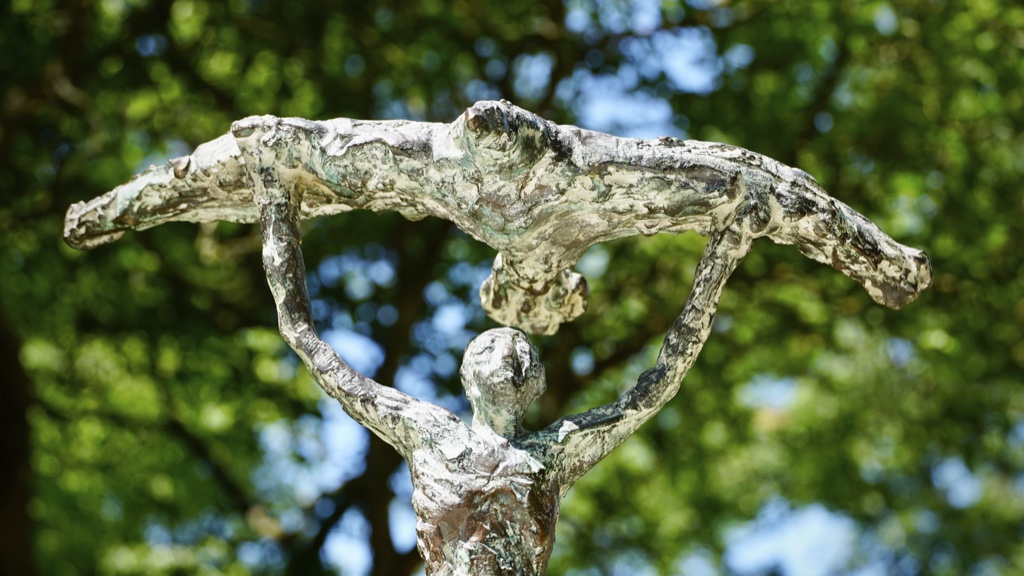
Her reclining or standing figures often appear vulnerable within their rough shells of concrete,
plaster, or bronze. Large and small figures, alone or in groups, as well as large and small animals,
appear seemingly imperfect to some viewers due to their tapered, sometimes missing limbs—yet it is
precisely through their supposed imperfection, and in some cases through their wild paintwork, that
they develop an incredible presence, even a distinct, very quiet form of a life of their own.
The artist has created a new work for the MKH-Biennale. Her figures do not conform; they view the
world through their own lens and embody Grzimek’s powerful perspective.
A discussion with her grandchild about the statement »god is dead« and the often confusing effect
of social media led to her latest work, titled »Nietzsche, ist tot«.
1 cf. Anita Wünschmann (Berliner Zeitung / 16.08.1998)
Sabina Grzimek
Graphic Artist / Sculptor
| Born in Rome in 1942; her father, Waldemar Grzimek, had received the Rome Prize in 1942 and spent a sabbatical with his wife, Christa von Carnap, a painter and ceramicist, at the Villa Massimo. | |
| 1961–62 | Practical training year at the porcelain manufactory |
| 1962–67 | Studied sculpture in Berlin-Weißensee |
| 1967–69 | Freelance sculptor, painter, and graphic artist in Berlin’s Prenzlauer Berg district |
| 1969–72 | Master’s student under Fritz Cremer at the Academy of Arts, Berlin |
| from 1972 | Freelance work in Berlin and Erkner |
| 1997–2006 | Visiting lecturer at the Graphic Design School, Anklam |
Awards
| 1972 | Gustav Weidanz Prize |
| 1983 | Käthe Kollwitz Prize |
| 1994 | Weinheim Art Promotion Association Prize |
| 1996 | Ernst Rietschel Art Prize of the City of Pulsnitz |
| 2011 | Brandenburg Art Prize – Honorary Prize from the Minister President of the State of Brandenburg for a Lifetime Achievement |
| 2012 | On her 70th birthday, installation of the sculpture »The One Rising from the Water« from the planned series »Seven Gestures of Upright Gait« at Garnisonskirchplatz, Berlin |
| 2014 | Installation of the second figure, »The Caller« |
| 2019 | Installation of the third figure, »The Thinker« |
| Seven more figures are still to be created. The life-size sculptures were created in 1996 and depict seven professors from Göttingen who rebelled against the constitution of the Kingdom of Hanover in 1837. Their moral courage was punished with dismissals and even death sentences, and the sculptures commemorate the victims of a dark chapter in German constitutional history. | |
Works in Public Collections (Selection)
| Lindenau Museum, Altenburg, Thuringia | |
| Kupferstichkabinett, Berlin | |
| Neue Nationalgalerie, Berlin | |
| Artothek at the German Bundestag | |
| Artothek of the Central and State Library, Berlin | |
| Art Collection of the Pankow District, Berlin | |
| Feininger Museum, Quedlinburg | |
| Art Collection of the Monastery of Our Lady, Magdeburg | |
| City of Heilbronn | |
| City of Weinheim and private collections |
Regular exhibitions in Germany and abroad since completing her studies