Peter Herrmann sits comfortably in his studio, leaning on his walking stick at his long table. Behind him are shelves filled to the brim with his work. Peter and his wife Anke always offer drinks or something to eat right away. Hospitality and conversations about art, life stories, and politics are always welcome at the Herrmanns’ home.
Herrmann’s large format oil painting, ›In the Saxon Forests‹ from 2003, depicts GDR soldiers preparing for the Russian invasion of 1968 to crush the Prague Spring. In the worst-case scenario, this explosive situation could have cost all these young men their lives. Because the subject matter is both thematically and historically gripping, the painting was jointly selected for the VI. MKH-Biennale. Peter explains that people are always looking for distractions and ways out; and that he imagined how these soldiers, out of necessity, sought simple pastimes and went mushroom picking in the forest. Herrmann had been discharged from the military and was working as a transport worker. During this time, he and his friend Peter Graf listened nonstop to »Radio Prague«, which was constantly interrupted by a jammer.
Time and again, he paints the people around him, observes his surroundings, and in his own way documents political events—as shown in the 2003 painting ›Victors of History on the Departure‹. Who writes history and who are the victors, if there are any at all? What it depicts is the seemingly periodic recurrence and transience of events. Born in 1937, he witnessed the destruction of Dresden, then that of Hamburg; in 1945, at the age of eight, he experienced the terrible postwar winter. He began drawing and, in 1961, participated in the exhibition »Young Artists, Painting« at the Academy of Arts in Berlin.
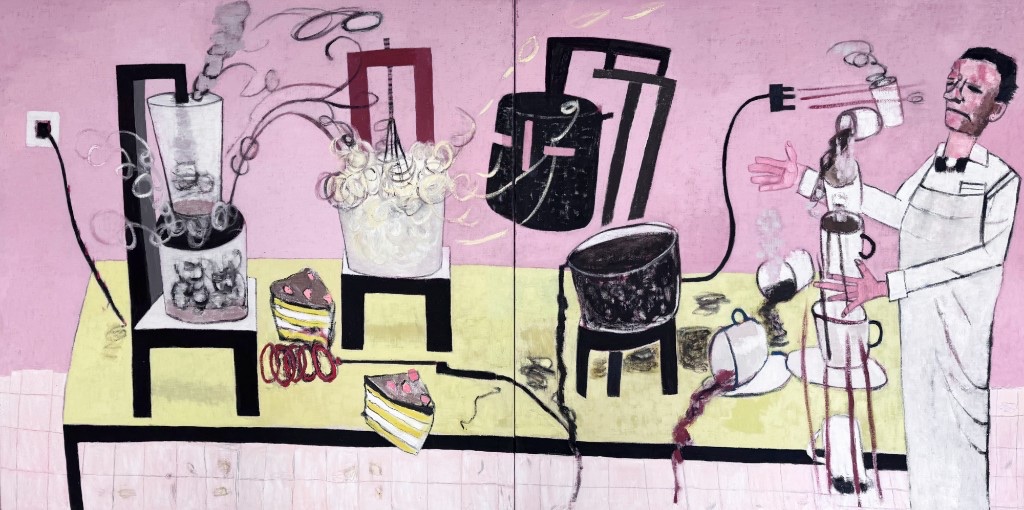
During a joint exhibition in Paris, Peter Herrmann was struck by lightning while on a boat ride on the Seine. The force of the strike tore him from his bench—Scheib, who had distrusted the umbrellas handed out from the start due to their conductive properties, feared for his friend’s life. Afterward, they laughed heartily about it and drank eight glasses of »Eau de Vie«, ›water of life‹, to celebrate their narrow escape. Faces from his circle of friends appear time and again in Herrmann’s works. He himself completed the bronze cast »Peter’s Head«, created by Scheib, with a bold paint job in shades of green. The sculpture stands prominently on a cabinet in Herrmann’s studio in Spandau, where the two worked next door to each other until recently. He says the following about his 2004 work »Aufruhr«: ›My interpretation is that the machine is fed up with always just making coffee for people. No one ever makes coffee for it.‹ In an era of rapidly advancing artificial intelligence, the work’s message suddenly takes on a whole new sense of urgency.
Peter Herrmann
Painter
| 1937 | Born in Großschönau/Lusatia; lives and works in Berlin-Spandau |
| 1951 | Apprenticeship as a chemical draftsman, Dresden |
| from 1953 | Participated in the painting circle at the adult education center led by Jürgen Böttcher/Strawalde; classmates and friends: Peter Graf, Winfried Dierske, Peter Makolies, and Ralf Winkler/A. R. Penck |
| 1971 | Worked as a freelance painter |
| 1974 | After protesting in the Central Executive Committee, ran again as a candidate for the VBK; later also became a member as a freelance painter |
| 1975 | Interview with Peter Graf and Henry Schumann for the book »Ateliergespräche« |
| 1977 | Co-founder of the Obergrabenpresse in Dresden |
| 1982 | Applied to leave the GDR |
| 1984 | Moved to Hamburg |
| 1985 | Stayed with A. R. Penck in London |
| since 1986 | in West Berlin |
Awards
| 1998 | Villa Romana Prize, Florence |
| 2001 | Fred Thieler Prize for Painting from the Berlinische Galerie, Berlin |
Works in Public Collections
- Ludwig Forum for International Art, Aachen
- State Museums of Berlin, National Gallery, Berlin
- Berlinische Galerie, State Museum of Modern Art, Photography, and Architecture, Berlin
- Collection of Contemporary Art of the Federal Republic of Germany
- Dieselkraftwerk Art Museum, Cottbus
- State Art Collections, Galerie Neue Meister/Kupferstichkabinett, Dresden
- Künstlerhaus Villa Romana, Florence
- Art Collection of the Deutsche Bundesbank, Frankfurt am Main
- Museum Ludwig, Cologne
- Museum of Fine Arts, Leipzig
- Kunstmuseum Unser Lieben Frauen, Magdeburg
- Haus der Geschichte der Bundesrepublik Deutschland, Bonn
- Embassy of the Federal Republic of Germany in Washington, D.C.
Regular exhibitions in Germany and abroad since 1961